Monday edition
October 12, 2026
Today’s lead remembers Mart Allen. Other stories are prepared from public sources, with source dates retained and business interpretations identified.
NORTHEAST — ADIRONDACKS / IN MEMORIAM
Mart Allen, Adirondack Forester and Friend to Many, Dies at 99
Remembering Mart Allen (1927–2026), Adirondack woodsman, ranger and friend.
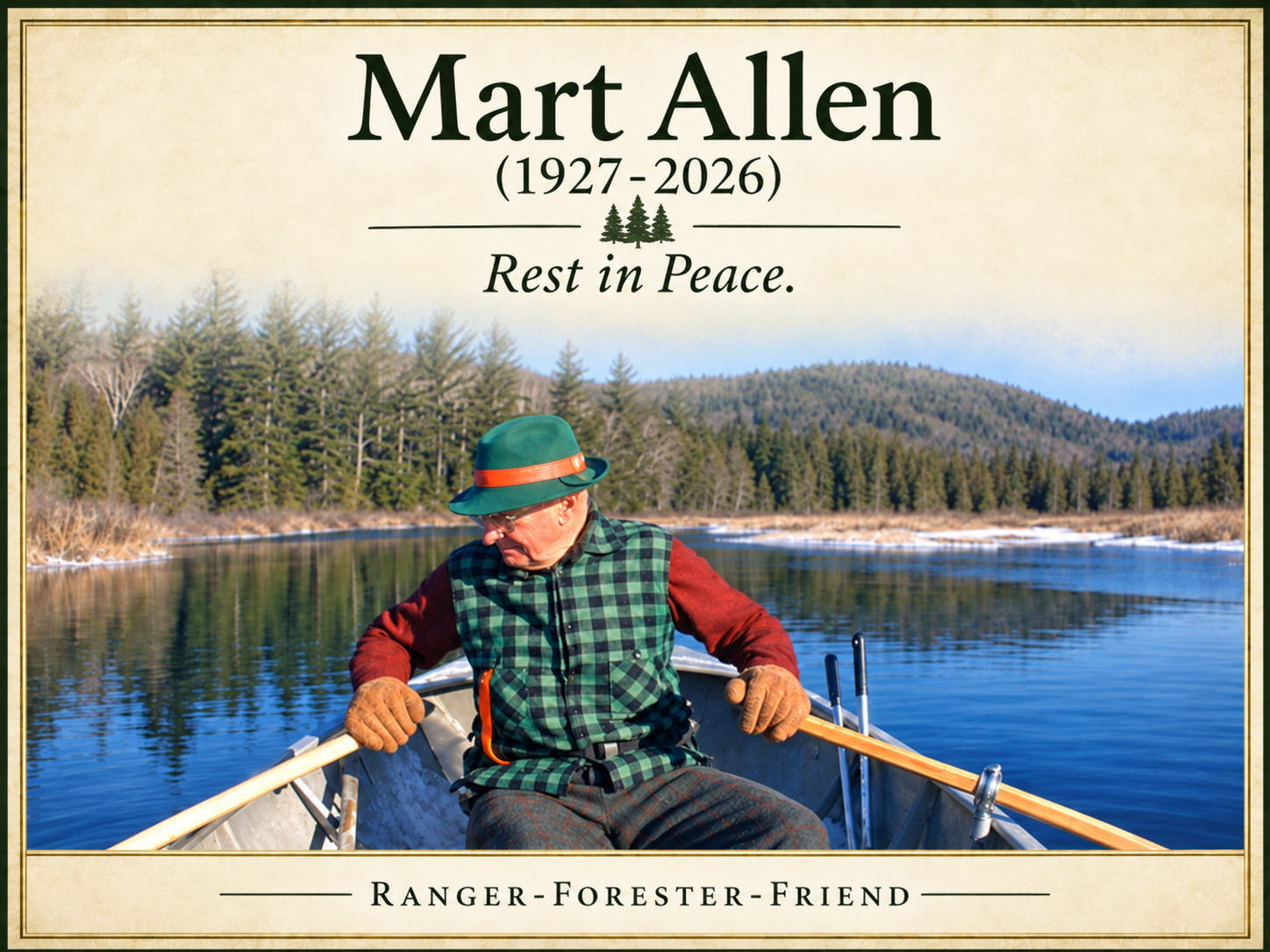
Mart Allen, a well-known Adirondack forester, former New York State forest ranger, and friend to many, passed away on October 11, 2026, at the age of 99.
After graduating from high school, Mart joined the U.S. Army and served in the occupation of Japan, where he found time to hunt pheasants and make friends among the local people. Following his military service, he attended the New York State Ranger School and went on to work for a year at Huntington Forest in Newcomb.
His career then took him across the country to Idaho, where he worked for the U.S. Forest Service. Returning to his native New York, Mart became the first New York State forest ranger appointed through a civil service examination. He patrolled the Adirondacks before being promoted to district ranger, serving in Central New York.
Mart subsequently joined the Adirondack League Club, where he rose through the ranks to become general manager. He retired from that position in 1992, but retirement did little to slow him down. He continued working as a consulting forester for many years afterward.
Mart was a character. He sometimes referred to himself as “the boy with two eyes,” and he insisted on practicality. His bark was worse than his bite—and there was certainly no shortage of barking. Beneath that gruff exterior was a man who went out of his way to help others, a friend to many, and a true force of nature.
He belonged to a generation of Adirondack woodsmen whose knowledge of the forests was matched by their knowledge of the people who lived and worked among them. He leaves behind countless stories and many grateful friends. The backwoods community of the Adirondacks will miss him.
Mart is survived by his wife, Nancy; three daughters; numerous grandchildren and great-grandchildren; and many friends. His only son, Marty, preceded him in death in 1989.
Ranger. Forester. Friend. Rest in peace, Mart.
Memorial image supplied by the publication owner.
By the Numbers
121 million board feet and $29.8 million: BLM’s reported July–September 2026 timber sales and revenue. These are sale figures, not delivered production. BLM report →
8,020 tons: estimated sawlogs in Case for Potomac; bids open October 13 at 2 p.m. Mountain. DNRC prospectus →
10 contiguous acres: North Carolina’s minimum qualifying Helene-impacted timber area, with additional damage and county requirements. Applications close today. Program requirements →
April 1, 2027–March 31, 2029: project completion period described for FESBC’s new October 15 intake. Funding announcement →
Mills & Markets
WEST — FEDERAL TIMBER / SUPPLY
BLM reports third-quarter sales and an October offering plan
BLM’s October 7 release reports approximately 121 million board feet sold across 5,300 acres in Oregon, Washington, Wyoming and Idaho during July–September 2026, generating $29.8 million in revenue. The agency also plans nine October sales offering about 46 million board feet across more than 1,200 acres.
Those figures describe timber sold and planned offerings, rather than wood already harvested or delivered. BLM’s sale directory links to regional plans, notices and prospectuses; individual sale documents determine the actual bidding and operating requirements.
Our procurement interpretation: use the national report as a signal to inspect the relevant regional offering list. A useful supply calculation needs the particular products, delivery destination, work windows and contract costs. Sold volume enters production on a different schedule from the auction, and a planned monthly total is not a guarantee that every offering will be purchased.
Watch: individual offerings, operating windows and the schedule from purchase to delivery.
BLM’s dated quarterly report → Official regional timber-sale directory →
CANADA — QUÉBEC / BUSINESS INVESTMENT
New equipment promotion still needs an asset-level tax check
Canada’s October 9 release from a visit to Ferreol Skis in Beaupré highlights the proposed Productivity Mega Deduction as an incentive for equipment and technology investment. Finance Canada’s underlying September 15 backgrounder describes proposed permanent immediate expensing for a broader range of depreciable assets acquired on or after September 15, 2026.
The backgrounder also specifies excluded asset classes and conditions for used property. It distinguishes immediate expensing from the treatment of other assets. The proposal and its promotional release do not establish that a particular forestry machine, vehicle or building qualifies.
Our business interpretation: start with the operating improvement and the full investment cost, then have the business’s tax adviser confirm applicable enacted rules, asset classification and the year the property becomes available for use. An earlier deduction can affect tax timing; it is not a grant paying the purchase price. The investment still needs a credible productivity and cash-flow case.
Watch: applicable enacted rules, asset classification and available-for-use timing.
October 9 government announcement → Finance proposal, restrictions and draft legislation links →
Action Detector
SOUTH — NORTH CAROLINA / DEADLINE TODAY
Timber-loss relief applications close at 5 p.m.
North Carolina’s second Timber Loss Relief Program application period closes today, October 12, at 5 p.m. local time. Both the Forest Service program page and the state recovery office continue to list October 12. Eligible owners need at least 10 contiguous acres of Helene-impacted timber with moderate or greater damage in one of 39 disaster counties.
New applicants begin with the county ranger or supervising district office. Owners who applied in the first period do not reapply. Damage assessment reports for second-period applications are separately due October 26 at 5 p.m.
Our immediate priority: confirm the application’s submission and required documents with the program office. The later assessment deadline does not extend today’s application window. Do not infer a deadline extension from the holiday calendar; follow the published instructions and obtain a clear submission record.
NC Forest Service instructions and forms → State recovery office’s current deadline →
WEST — MONTANA / BID TOMORROW
Case for Potomac bids must arrive before Tuesday’s opening
DNRC’s current listing confirms the Case for Potomac bid opening on October 13, 2026, at 2 p.m. Mountain, at 2705 Spurgin Road in Missoula. The official package offers approximately 8,020 tons of mixed-conifer sawlogs and requires a $2,496 bid deposit. Hand-delivered or mailed bids must arrive before opening; the agency recommends confirming receipt.
The prospectus anticipates non-operable seasonal conditions from mid-October through November and March through mid-June. It also sets road-maintenance and herbicide obligations, and a July 31, 2029 harvest deadline.
Our final bid review: check the signed forms, deposit, delivery method and receipt, then confirm that the operating estimate includes the usable seasons and required work. Estimated volumes and costs are not guarantees. Tomorrow’s deadline is a submission decision, not the start of an unrestricted year-round harvest.
Official notice, prospectus and maps → Current DNRC sale listing →
CANADA — BRITISH COLUMBIA / OCTOBER 15 OPENING
FESBC’s new intake targets wildfire risk and rehabilitation
The Forest Enhancement Society of BC’s September 22 announcement schedules a new intake to open October 15, 2026, for priority wildfire-risk reduction and forest-ecosystem rehabilitation. It describes eligible projects to be completed between April 1, 2027, and March 31, 2029. October 15 is the opening date in that announcement, not a stated closing deadline.
The current funding page directs applicants to read the applicable program guide, speak with the regional operations manager, and then use the FESIMS application portal. It currently links guides for fibre utilization and wildfire-risk reduction; confirm the guide governing this new intake with the manager.
Our project-planning interpretation: define the proposed treatment, location, ownership permissions, costs and completion schedule before applying. Identify what result the funding would buy and which party will carry out the work. A general interest in biomass or fuel reduction is not enough to establish project eligibility.
New-intake announcement and project period → Guides, regional managers and application sequence →
Under the Radar
MIDWEST — INDIANA / PROPOSED FOREST WORK
Sigler Creek proposal combines oak woodland and stream treatments
The Hoosier National Forest announced its Sigler Creek Collaborative Woodlands and Wildlife proposal October 6; WBIW reported details October 7. The project concerns northern Perry and southern Crawford counties. Proposed work includes tree planting and timber management, prescribed burning and a culvert replacement intended to improve aquatic habitat.
The announcement invites public feedback, preferably within 30 days of the release, and directs readers to the forest’s project documents. Review the actual proposed action and confirm the comment process with the forest. This is a proposal under review, not an awarded timber sale or an invitation to begin work.
Our management interpretation: read the treatments together. A habitat objective may require changes to canopy, regeneration, fuels and stream access, rather than a single stand prescription. Comments are most useful when they identify a specific treatment, location or operating constraint and explain how it affects the stated objectives.
Original Forest Service announcement → Dated local account and comment instructions →
NORTHEAST — MAINE / OCTOBER 16 REVIEW
Old-growth strategy work reaches a public final-review meeting
Maine’s Late-Successional and Old-Growth Forest Conservation Strategies Work Group lists a final-review and feedback meeting for October 16, 2026, from 9 a.m. to 12:30 p.m. Maine time. The public may attend at 90 Blossom Lane, Deering Building, Room 101, in Augusta, or online with advance Zoom registration. A short public-comment period is planned near the end.
The linked September 30 draft examines voluntary conservation approaches, ecological management, certification and market-based tools. It acknowledges the importance of private working forests and evaluates strategies against participation, conservation effectiveness, stakeholder impact and financial support. The document remains a draft; it is not a new binding harvest rule.
Our practical reading: review a strategy in terms of who participates, who pays and what changes on the land. Bring a specific field or ownership example to the discussion. Confirm registration and meeting materials on the official event page before attending.
Official meeting, registration and documents → September 30 draft conservation-strategy report →
FOREST BUSINESS SCHOOL RESOURCE
Put practical emergency information where the crew can use it
The free Woods-Ready Safety Plan app helps loggers and foresters prepare a site-specific emergency response plan. It was built for the Northeastern Loggers’ Association with grant funding from the National Timber Harvesting and Transportation Safety Foundation.
Prepare the plan, review responder directions and contacts with the crew, and make sure everyone knows where to find it. Check the details when a job, access route or crew changes. Practical preparation matters most when people can use the information under pressure.
Prepare a Woods-Ready Safety Plan → Forest Business School →
FEATURED BOOK
Wet Woods
Today’s featured title from Steven Bick.
Useful enough to pass along?
Share today’s edition with a colleague.